
If your organisation has noticed that responding to information requests takes longer, costs more, and feels riskier than it did five years ago, the data backs up what your team is feeling. Across the Australian government, the volume of formal information requests is increasing, which means the time to answer them keeps stretching. This leads to the information itself spreading across more systems than any one person can search.
WyldLynx has helped Australian agencies, councils, and universities manage their records and respond to access requests since 2009. This is a problem we encounter firsthand.
Here is what the numbers show, why it is getting harder, and where the real overhead hides.
|
43,456 FOI requests to Commonwealth agencies in 2024-25 |
+25% increase in one year (from 34,706 in 2023-24) |
11,356 requests still on hand at year end, up 57% |
Source: Office of the Australian Information Commissioner (OAIC) Annual Report 2024-25.
What counts as a request for information in Australia?
A request for information (RFI) is any formal ask for records an organisation holds. In Australian government, most arrive through statutory access schemes rather than informal channels. The wording changes by jurisdiction, but the obligation is the same. We look to find the relevant records, decide what can be released, and respond within a legal timeframe.
- Commonwealth: Freedom of Information (FOI) under the Freedom of Information Act 1982
- Queensland: Right to Information (RTI) under the Right to Information Act 2009
- New South Wales: Government Information (Public Access), known as GIPA, under the GIPA Act 2009
- Victoria, WA, SA, Tasmania, ACT and NT: their own FOI or information access Acts, each with local rules and timeframes
Private sector and regulated organisations field their own version of the same pressure: subject access and correction requests under the Privacy Act 1988, regulator notices, audit and discovery requests, and customer demands to see what data is held about them. Under a different label, but the task is the same. Locate the right information fast and stand behind the result.
A short history: from closed government to a million requests
Before 1982, Australian governments had no general obligation to release information to the public. The Westminster tradition kept government records largely closed. That changed when the Commonwealth passed the Freedom of Information Act 1982, which commenced on 1 December 1982 and gave people a legal right of access to documents held by the government.
Every state and territory followed. By the 2000s, FOI, RTI and GIPA schemes covered the whole country. The Office of the Australian Information Commissioner (OAIC) was established in 2010 to oversee the Commonwealth scheme, and that same year, a major reform removed application fees and made access to your own personal information free of charge.
That 2010 reform removed a brake. Once cost stopped being a barrier, the volume of requests had only one direction to go: up.
The scale is hard to overstate. The Australian National Audit Office records that more than one million access applications have been made under the Commonwealth FOI Act since it began. What started as a constitutional principle has become a high-volume operational workload sitting on the desks of records and legal teams across the country.
Why getting this right still matters
Information access is not a back-office nicety. It is part of the accountability framework that keeps government trusted, and for regulated organisations it is a legal duty with real consequences. Three things ride on every response.
- Legal compliance. Each scheme sets a statutory clock, usually around 30 days. Miss it and the request can become a “deemed refusal,” which the applicant can escalate to the regulator. The decision then leaves your hands.
- Public trust and transparency. Slow or incomplete responses erode confidence in the organisation and invite complaints, reviews, and media attention.
- Defensibility. A response is only as good as the search behind it. If you cannot show you looked everywhere the records could be, you cannot stand behind “we have provided everything.”
That last point is where the modern challenge bites hardest, and it leads straight to the next question.
Why growing data volume makes every request harder
The obligation has not changed much since 1982. The information environment has changed beyond recognition. A request that once meant pulling a paper file from a registry now means searching across email, network drives, SharePoint, Teams and other messaging apps, line-of-business systems, cloud storage, and an electronic records system that may or may not hold the relevant document.
The OAIC’s own 2024 survey of FOI practitioners puts a number on the fragmentation: 64% of Australian Government agencies reported running multiple, separate electronic records management systems, while only 29% had a single integrated system. Tellingly, agencies with integrated records and clear policies rated their ability to handle FOI requests far more positively than those without.
When a request arrives, more than half of these agencies are not searching in one place. They are searching many, with no single map of where everything lives.
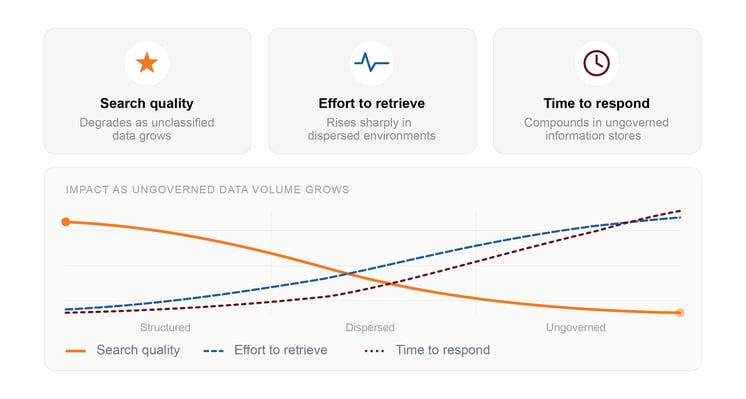
Every new system, channel, and copy adds another place a relevant record might hide, and another place a search can miss. The data keeps growing; the obligation to find all of it inside 30 days does not move. That gap is the source of the overhead.
The specific challenges that combine into one overhead
On their own, each of these is manageable. Stacked together, on every request, across a rising caseload, they become a permanent drain on records, legal, and corporate teams.
1. Finding the records (and proving you found them all)
The single hardest part is no longer reading documents; it is locating them. “Adequacy of searches” under section 24A of the FOI Act is one of the reasons the OAIC prioritises for review, which tells you how often applicants challenge whether an agency really looked properly. When records are scattered across many systems, a thorough search takes longer, and a complete one is harder to guarantee.
2. The statutory clock
Compliance with the legal timeframe is slipping under the weight. Across the Commonwealth, 74% of FOI requests were decided within the statutory time in 2023-24, meaning roughly one in four were late. At individual agencies under pressure, the picture is worse. The National Disability Insurance Agency made a decision on only 33% of requests within the allotted time frame in 2024-25. Late decisions generate reviews, complaints, and rework.
3. Redaction and exemption review
Finding a document is only the start. Someone still has to read it, apply the right exemptions, redact third-party and personal information, and write a defensible decision. The personal privacy exemption alone accounts for around 39% of all exemptions claimed, and most requests touch personal information, so this manual review happens on nearly every file.
4. The rising caseload behind it all
None of this is happening at a steady state. Commonwealth requests rose 25% in a single year, and the backlog of requests on hand at year's end grew 57%. More requests, against more data, with the same timeframe, means the overhead compounds rather than holds steady.
5. The cost
Put together, this carries a real price. The total cost of administering FOI across Commonwealth agencies reached $97.99 million in 2024-25, up 14% in one year, with the biggest drivers being the time taken to process requests and rising legal expenditure. That is staff time pulled away from other work, and it is growing.
The thread that connects every one of these
Look across the five challenges, and a single root cause runs through them. Search adequacy, missed deadlines, redaction load, rising caseload, and cost all get worse as information spreads across more systems and as the share of data nobody has classified grows. You cannot search quickly, completely, or defensibly through information you have never mapped.
The agencies that report coping best are the ones that know what they hold and where it lives. The ones under the most strain are the ones running many systems with no unified view. The difference is not effort or headcount; it is visibility.
Talk to us about your information request workload
If your team is feeling the squeeze of rising requests, scattered data, and a clock that never stops, we can help you get a clearer picture of what you hold and how to find it faster.
Talk to WyldLynx about reducing the effort behind every information request.